




I’m probably a bit late to the party, but it’s taken me a while to fully appreciate and invest money into my pension.
When I look at my own mindset around money this is partly because I have a general belief that if I need more money, I’ll figure out a way to make it. A good career path, side hustles, reselling unneeded items. These are all things that can increase my income.
Yet the older I get the more I see the reality of a time when I might not want to hustle to keep money coming in. Won’t it be nice in my retirement years to not have to stress about how I’m going to cover day to day expenses? Yes. Yes it would be.
So to achieve that, I need to start building my pension.
Pension Savings is Future Pay
I was recently doing a bit of a LinkedIn doom scroll and came across a post where the caption noted “pension savings is future pay.” (Full disclosure, I closed the page before I realised this sentence would spark an article idea and now I can’t find the name of the poster. Nor do I know if he was the originator of that concept. Either way, if I come across it again, I will give him a shout out here.)
The post was in refence to the way that the pension contributions you make are referred to as “deductions” from your pay. Which, though mostly correct, does not accurately describe what a pension is. To see it as a deduction makes it feel like you’re missing out on that money. You’re not. It’s money for retirement. It’s future pay. So simple and clear when it’s put that way. Not to mention how that outlook almost automatically makes investing into your pension feel easier and more desirable.
Save for the Future or Live for the Now?
Adam Nettleship, Bigmores CEO and Chartered Financial Planner, previously wrote an article about striking a balance between saving for the future and living for the now. A good financial life will have space for both. I still struggle with the concept of savings. Life is getting expensive. Not just because I have two growing boys but because of worldwide economic factors and the general cost of living. Plus, the nature of consumerism and overconsumption needs to be kept in check.
Yet the other reason I wonder if I’m not the best at saving is because it wasn’t a message I received as a child. I grew up not having to worry about the now, but was never taught to think about the future. Was never taught the importance of an emergency fund or retirement savings. Growing up in America, there’s a thing called a 401K. I left the States when I was in my mid 20s. Didn’t know what a 401K was then, and still don’t know now, really.
Like Parent, Like Child
When I put the call out to members of the Bigmores team for thoughts around pension mindset, one of my colleagues mentioned that he has been building his pension since he started working. This is because his parents taught him the importance of doing that. He also saw them retire in their mid 50’s which has certainly been an inspiration for him to build his savings.
He also pointed out that some of his friends have not had the same enthusiasm for their pension. The parallel he drew was around the fact that their parents never taught them the importance of building that pot. So they never did.
The fact that your childhood experiences have an unconscious impact on your today habits has come up in many of our articles. As has the importance of questioning why your thoughts and habits are what they are. Knowing why you believe and why you do what you do helps you make changes. Understanding that some beliefs are learned, and might not be how you truly think and feel, means you can unlearn them and create new ones. Ones that will see future you earning a good living off of the pension that current you paid into. Because remember, Pension savings is future pay.
The Bank of Mum and Dad
And speaking of childhood habits… it comes up frequently for our Financial Advisers that adults who were well provided for as children without any reality check of their own future personal finances, are often times unenthusiastic about saving for retirement. Taking that further, clients often come in noting that their retirement plan is inheritance. For some, this might be the case. Yet there are far too many unknowns that can change this perceived reality.
People are living longer lives now. And the cost of care in old age is rising. Though your parents/relatives might be well off currently, with the expectation you will be left a nice sum of money, there is every possibility that the cost of their care could mean that pot is significantly depleted. Not to mention that if the estate is over the threshold, a 40% inheritance tax could apply. (Download our Guide to Inheritance Tax for further details.)
Basically, relying on inheritance isn’t the most straightforward, or (dare I say) ‘grown up’ way to approach retirement. And the unfortunate reality of life is, at some point we have to be grown-ups and do all those boring things that grown-ups do.
The Benefit of Age
Another clear trend that’s coming up from the input of my colleagues is that the older they get, the more they understand the need for a pension. (Sounds like me!!) When you’re young it is very easy to ignore the future. Life seems full of possibilities and when you’re making money for the first time, it’s more exciting to spend it on what you want now.
Building your pension from the start of your career offers many benefits. We’re going to consider two of them. The first being that it’s easier to form the habit new than it is to try to change it in the future. If pension contributions are what you do from day one, it will be easy to continue doing so as your career progresses. Plus, it is likely that your disposable income will be higher prior to certain financial obligations that might come up in later life. Things such as mortgage payments, insurances, children, etc.
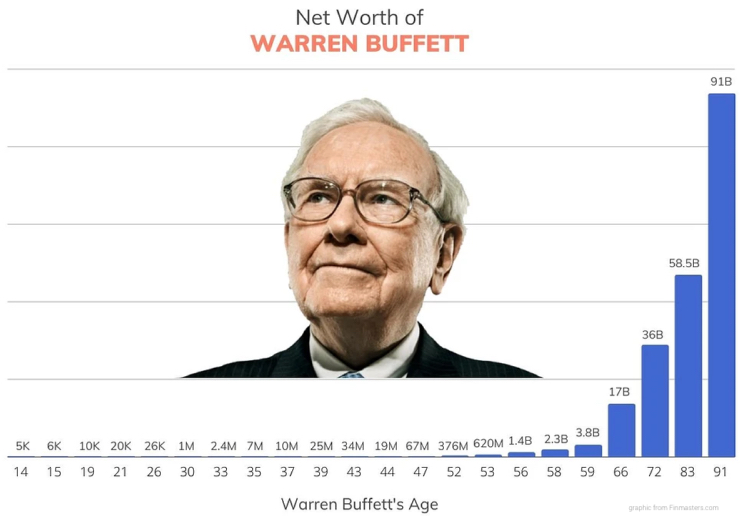
The second thing we are going to look at is the benefit of compound interest. If you learn one thing from Warren Buffett, it should be the power of compounding. Basically, your money can earn you money through interest. The higher the amount of money you have in your pension, the more interest it can earn over time. I’ve put a handy chart below that outlines how compound interest impacted Warren Buffett’s wealth over time. For more information on the subject, watch this video by Bigmore’s Director of Investments, Julian Strauss.
Salary Sacrifice and Other Tax Benefits
If your employer offers a Salary Sacrifice Pension, pension contributions are deducted before income tax and National Insurance (NI) are applied. This means you receive tax relief at your highest marginal rate and avoid paying NI on the portion of salary going into your pension.
Some employers go a step further by paying their own NI savings into your pension as an additional contribution. In some schemes, employees can also choose to redirect their NI savings into their pension, increasing the amount invested even further. It’s a good idea to know exactly what your employer offers and to take some guidance on how to maximise it in a way that suits you.
If you contribute to a personal pension or a workplace pension that operates under a relief-at-source arrangement rather than salary sacrifice, there are still tax relief benefits. Basic-rate tax relief is added automatically, meaning a contribution of £80 is topped up to £100 in your pension. Higher and additional-rate taxpayers can then claim further relief through their self-assessment tax return. This helps reduce your tax bill and potentially generate a tax refund, depending on your circumstances.
When it comes to retirement most people can currently take up to 25% of their pension benefits tax-free, subject to a maximum tax-free lump sum of £268,275. It’s important to note that you don’t have to be take it all at once. In many cases, drawing tax-free cash gradually can be more beneficial because the remaining funds stay invested and continue growing. (If you’re at this stage and not sure what to do, seek professional financial advice.)
What You Think Matters
The point of this article is to show you that your mindset around finances matter. This includes pensions. There can be dozens if not hundreds of reasons you think they way you think about building your pension pot. If you don’t know what formed your viewpoint, it’s a good idea to try to figure it out. Especially if you want to change it.
I think the best phrase to help you build a new mindset, should that be what you need to do to secure finances for your retirement, is the sentence mentioned above;
Pension Savings is Future Pay.
Article by Jill Rensing
Money Mindset Coach
Here are some other Insights we think you would like:
Do Unmarried Couples Need a Will?
Previous post



